
Quarterly Impact Report
Environmental rule of law, human rights, and a global design award.

Dear all,
The second quarter of 2026 has brought new partnerships, expanded programs, and recognition for how we communicate metrics. Across continents, the World Justice Project (WJP) continues to translate data into action — from assessing environmental rule of law in Asia to strengthening accountability for human rights violations — through evidence, co-creation, and local implementation.
Programs in Motion
Environmental Rule of Law in Asia: WJP is piloting a new environmental rule of law assessment in Thailand and the Philippines, with a focus on air quality and climate change, in partnership with the Asian Development Bank. The project will produce interactive country dashboards built on fresh, original data.
Accountability and Human Rights: In Quintana Roo, Mexico, we worked hand in hand with local activists, prosecutors, judges, and civil society to develop a concrete roadmap — publicly tracked on the prosecution’s own website — to improve investigation and prosecution of torture and extrajudicial killings.
Local Evidence: we’re building a Quebec-specific Rule of Law Index, adapting our unique methodology to the local context, in collaboration with the Quebec Bar and Léger.
On the Ground
Our team has been on the ground in 23 countries, participating in over 50 high-level engagements, keeping rule of law at the absolute center of the global agenda.
WJP opened the Dominican Republic’s Judiciary Conference with a direct challenge to the legal community seated before them: “You have an extraordinary power: to change how someone experiences their interaction with the rule of law by making it clearer, more trustworthy, more humane, and more just.”
Following our participation at the Human Rights Forum, WJP signed a Memorandum of Understanding with the Law Association for Asia and the Pacific (LAWASIA). This formalizes joint operations on judicial independence, human rights measurement, and environmental law.
WJP contributed to a new online course on AI and the Judiciary, developed by UNESCO and the University of Oxford, equipping judges, legal professionals, and policymakers to navigate high stakes, risks, and promises of AI in justice systems.
In the coming weeks, we look forward to participating in the UN General Assembly in New York.
Designing for Impact
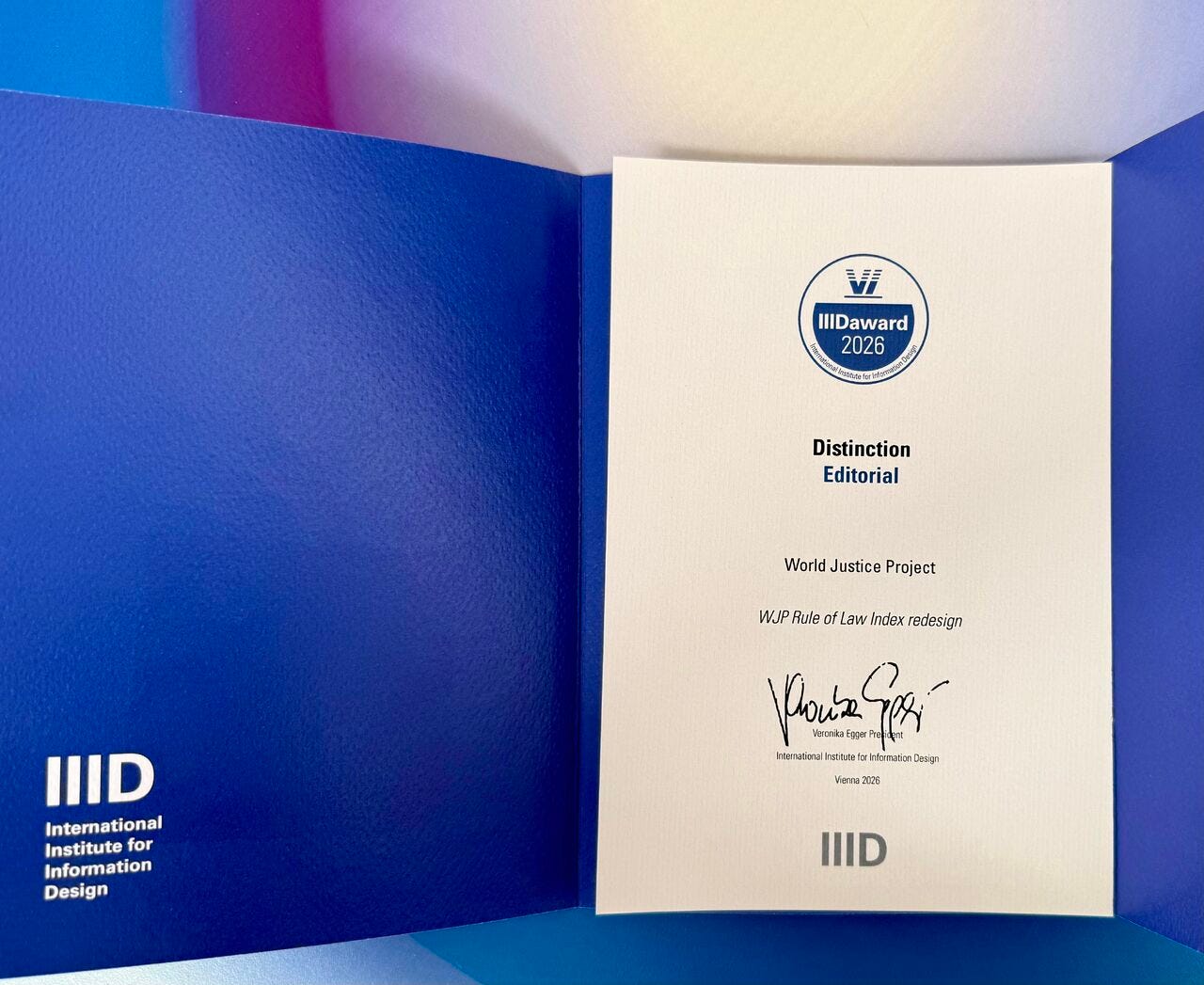
WJP was recognized with an International Institute for Information Design (IIID) Award for our redesign of the Rule of Law Index report — one of the highest honors in the field of information design.
We believe the rule of law deserves great design. Whether it’s a strategic brief for a lawmaker or an interactive dashboard, our goal is to make critical data universally usable, understandable, and actionable. Explore our behind-the-scenes design process here.
When the news breaks on rule of law, journalists reach for our data. Over the last couple of months, WJP has been used to cover erosion of electoral trust in the US (The Guardian) and Turkey (Financial Times and Le Monde), the future impact of AI on justice systems (Forbes) and the EU’s competitive business advantage of legal stability (Politico).
Our work stays independent and open because of your support. Donate to the World Justice Project today.
As always, if these updates surface areas of alignment or new opportunities for collaboration, we welcome the conversation.
Thank you for your continued commitment to a world where the rule of law is a lived reality for everyone.
Alejandro Ponce
Executive Director
World Justice Project